Gazan - The beast-mode reverse proxy.
Gazan is a Reverse proxy, service mesh based on Cloudflare's Pingora
What Gazan means? Gazan = Գազան = beast / wild animal in Armenian / Often used as a synonym to something great..
Built on Rust, on top of Cloudflare’s Pingora engine, Gazan delivers world-class performance, security and scalability — right out of the box.
🔧 Key Features
- Dynamic Config Reloads — Upstreams can be updated live via API, no restart required.
- TLS Termination — Built-in OpenSSL support.
- Upstreams TLS detection — Gazan will automatically detect if upstreams uses secure connection.
- Authentication — Supports Basic Auth, API tokens, and JWT verification.
- Basic Auth
- API Key via
x-api-keyheader - JWT Auth, with tokens issued by Gazan itself via
/jwtAPI- ⬇️ See below for examples and implementation details.
- Load Balancing Strategies
- Round-robin
- Failover with health checks
- Sticky sessions via cookies
- Unified Port — Serve HTTP and WebSocket traffic over the same connection.
- Memory Safe — Created purely on Rust.
- High Performance — Built with Pingora and tokio for async I/O.
🌍 Highlights
- ⚙️ Upstream Providers:
fileUpstreams are declared in config file.consulUpstreams are dynamically updated from Hashicorp Consul.
- 🔁 Hot Reloading: Modify upstreams on the fly via
upstreams.yaml— no restart needed. - 🔮 Automatic WebSocket Support: Zero config — connection upgrades are handled seamlessly.
- 🔮 Automatic GRPC Support: Zero config, Requires
sslto proxy, gRPC handled seamlessly. - 🔮 Upstreams Session Stickiness: Enable/Disable Sticky sessions globally.
- 🔐 TLS Termination: Fully supports TLS for upstreams and downstreams.
- 🛡️ Built-in Authentication Basic Auth, JWT, API key.
- 🧠 Header Injection: Global and per-route header configuration.
- 🧪 Health Checks: Pluggable health check methods for upstreams.
- 🛰️ Remote Config Push: Lightweight HTTP API to update configs from CI/CD or other systems.
📁 File Structure
.
├── main.yaml           # Main configuration loaded at startup
├── upstreams.yaml      # Watched config with upstream mappings
├── etc/
│   ├── server.crt      # TLS certificate (required if using TLS)
│   └── key.pem         # TLS private key
🛠 Configuration Overview
🔧 main.yaml
| Key | Example Value | Description |
|---|---|---|
| threads | 12 | Number of running daemon threads. Optional, defaults to 1 |
| user | gazan | Optional, Username for running gazan after dropping root privileges, requires to launch as root |
| group | gazan | Optional,Group for running gazan after dropping root privileges, requires to launch as root |
| daemon | false | Run in background (boolean) |
| upstream_keepalive_pool_size | 500 | Pool size for upstream keepalive connections |
| pid_file | /tmp/gazan.pid | Path to PID file |
| error_log | /tmp/gazan_err.log | Path to error log file |
| upgrade_sock | /tmp/gazan.sock | Path to live upgrade socket file |
| config_address | 0.0.0.0:3000 | HTTP API address for pushing upstreams.yaml from remote location |
| proxy_address_http | 0.0.0.0:6193 | Gazan HTTP bind address |
| proxy_address_tls | 0.0.0.0:6194 | Gazan HTTPS bind address (Optional) |
| tls_certificate | etc/server.crt | TLS certificate file path. Mandatory if proxy_address_tls is set, else optional |
| tls_key_file | etc/key.pem | TLS Key file path. Mandatory if proxy_address_tls is set, else optional |
| upstreams_conf | etc/upstreams.yaml | The location of upstreams file |
| log_level | info | Log level , possible values : info, warn, error, debug, trace, off |
| hc_method | HEAD | Healthcheck method (HEAD, GET, POST are supported) UPPERCASE |
| hc_interval | 2 | Interval for health checks in seconds |
| master_key | 5aeff7f9-7b94-447c-af60-e8c488544a3e | Master key for working with API server and JWT Secret generation |
🌐 upstreams.yaml
provider:fileorconsul- File-based upstreams define:
- Hostnames and routing paths
- Backend servers (load-balanced)
- Optional request headers, specific to this upstream
- Global headers (e.g., CORS) apply to all proxied responses
- Optional authentication (Basic, API Key, JWT)
🛠 Installation
Download the prebuilt binary for your architecture from releases section of GitHub repo
Make the binary executable chmod 755 ./gazan-VERSION and run.
File names:
| File Name | Description |
|---|---|
gazan-x86_64-musl.gz |
Static Linux x86_64 binary, without any system dependency |
gazan-x86_64-glibc.gz |
Dynamic Linux x86_64 binary, with minimal system dependencies |
gazan-aarch64-musl.gz |
Static Linux ARM64 binary, without any system dependency |
gazan-aarch64-glibc.gz |
Dynamic Linux ARM64 binary, with minimal system dependencies |
🔌 Running the Proxy
./gazan -c path/to/main.yaml
🔌 Systemd integration
cat > /etc/systemd/system/gazan.service <<EOF
[Service]
Type=forking
PIDFile=/run/gazan.pid
ExecStart=/bin/gazan -d -c /etc/gazan.conf
ExecReload=kill -QUIT $MAINPID
ExecReload=/bin/gazan -u -d -c /etc/gazan.conf
EOF
systemctl enable gazan.service.
systemctl restart gazan.service.
💡 Example
A sample upstreams.yaml entry:
provider: "file"
sticky_sessions: false
to_https: false
headers:
  - "Access-Control-Allow-Origin:*"
  - "Access-Control-Allow-Methods:POST, GET, OPTIONS"
  - "Access-Control-Max-Age:86400"
authorization:
  type: "jwt"
  creds: "910517d9-f9a1-48de-8826-dbadacbd84af-cb6f830e-ab16-47ec-9d8f-0090de732774"
myhost.mydomain.com:
  paths:
    "/":
      to_https: false
      headers:
        - "X-Some-Thing:Yaaaaaaaaaaaaaaa"
        - "X-Proxy-From:Hopaaaaaaaaaaaar"
      servers:
        - "127.0.0.1:8000"
        - "127.0.0.2:8000"
    "/foo":
      to_https: true
      headers:
        - "X-Another-Header:Hohohohoho"
      servers:
        - "127.0.0.4:8443"
        - "127.0.0.5:8443"
This means:
- Sticky sessions are disabled globally. This setting applies to all upstreams. If enabled all requests will be 301 redirected to HTTPS.
- HTTP to HTTPS redirect disabled globally, but can be overridden by
to_httpssetting per upstream. - Requests to
myhost.mydomain.com/will be proxied to127.0.0.1and127.0.0.2. - Plain HTTP to
myhost.mydomain.com/foowill get 301 redirect to configured TLS port of Gazan. - Requests to
myhost.mydomain.com/foowill be proxied to127.0.0.4and127.0.0.5. - SSL/TLS for upstreams is detected automatically, no need to set any config parameter.
- Assuming the
127.0.0.5:8443is SSL protected. The inner traffic will use TLS. - Self signed certificates are silently accepted.
- Assuming the
- Global headers (CORS for this case) will be injected to all upstreams
- Additional headers will be injected into the request for
myhost.mydomain.com. - You can choose any path, deep nested paths are supported, the best match chosen.
- All requests to servers will require JWT token authentication (You can comment out the authorization to disable it),
- Firs parameter specifies the mechanism of authorisation
jwt - Second is the secret key for validating
jwttokens
- Firs parameter specifies the mechanism of authorisation
🔄 Hot Reload
- Changes to
upstreams.yamlare applied immediately. - No need to restart the proxy — just save the file.
- If
consulprovider is chosen, upstreams will be periodically update from Consul's API.
🔐 TLS Support
To enable TLS for A proxy server: Currently only OpenSSL is supported, working on Boringssl and Rustls
- Set
proxy_address_tlsinmain.yaml - Provide
tls_certificateandtls_key_file
📡 Remote Config API
Push new upstreams.yaml over HTTP to config_address (:3000 by default). Useful for CI/CD automation or remote config updates.
URL parameter. key=MASTERKEY is required. MASTERKEY is the value of master_key in the main.yaml
curl -XPOST --data-binary @./etc/upstreams.txt 127.0.0.1:3000/conf?key=${MASTERKEY}
🔐 Authentication (Optional)
- Adds authentication to all requests.
- Only one method can be active at a time.
basic: Standard HTTP Basic Authentication requests.apikey: Authentication viax-api-keyheader, which should match the value in config.jwt: JWT authentication implemented viagazantoken=url parameter./some/url?gazantoken=TOKENjwt: JWT authentication implemented viaAuthorization: Bearer <token>header.- To obtain JWT a token, you should send generate request to built in api server's
/jwtendpoint. master_key: should match configuredmasterkeyinmain.yamlandupstreams.yaml.owner: Just a placeholder, can be anything.valid: Time in minutes during which the generated token will be valid.
- To obtain JWT a token, you should send generate request to built in api server's
Example JWT token generation request
PAYLOAD='{
    "master_key": "910517d9-f9a1-48de-8826-dbadacbd84af-cb6f830e-ab16-47ec-9d8f-0090de732774",
    "owner": "valod",
    "valid": 10
}'

TOK=`curl -s -XPOST -H "Content-Type: application/json" -d "$PAYLOAD"  http://127.0.0.1:3000/jwt  | cut -d '"' -f4`
echo $TOK
Example Request with JWT token
With Authorization: Bearer header
curl -H "Authorization: Bearer ${TOK}" -H 'Host: myip.mydomain.com' http://127.0.0.1:6193/
With URL parameter (Very useful if you want to generate and share temporary links)
curl -H 'Host: myip.mydomain.com' "http://127.0.0.1:6193/?gazantoken=${TOK}`"
Example Request with API Key
curl -H "x-api-key: ${APIKEY}" --header 'Host: myip.mydomain.com' http://127.0.0.1:6193/
Example Request with Basic Auth
curl -u username:password -H 'Host: myip.mydomain.com' http://127.0.0.1:6193/
📃 License
🧠 Notes
- Uses Pingora under the hood for efficiency and flexibility.
- Designed for edge proxying, internal routing, or hybrid cloud scenarios.
- Transparent, fully automatic WebSocket upgrade support.
- Transparent, fully automatic gRPC proxy.
- Sticky session support.
- HTTP2 ready.
📊 Why Choose Gazan? – Feature Comparison
| Feature | Gazan | Nginx | HAProxy | Traefik |
|---|---|---|---|---|
| Hot Reload | ✅ Yes (live, API/file) | ⚠️ Reloads config | ⚠️ Reloads config | ✅ Yes (dynamic) |
| JWT Auth | ✅ Built-in | ❌ External scripts | ❌ External Lua or agent | ⚠️ With plugins |
| WebSocket Support | ✅ Automatic | ⚠️ Manual config | ✅ Yes | ✅ Yes |
| gRPC Support | ✅ Automatic (no config) | ⚠️ Manual + HTTP/2 + TLS | ⚠️ Complex setup | ✅ Native |
| TLS Termination | ✅ Built-in (OpenSSL) | ✅ Yes | ✅ Yes | ✅ Yes |
| TLS Upstream Detection | ✅ Automatic | ❌ | ❌ | ❌ |
| HTTP/2 Support | ✅ Automatic | ⚠️ Requires extra config | ⚠️ Requires build flags | ✅ Native |
| Sticky Sessions | ✅ Cookie-based | ⚠️ In plus version only | ✅ | ✅ |
| Prometheus Metrics | ✅ Built in | ⚠️ With Lua or exporter | ⚠️ With external script | ✅ Native |
| Built With | 🦀 Rust | C | C | Go |
💡 Simple benchmark by Oha
⚠️ These benchmarks use :
- 3 async Rust echo servers on a local network with 1Gbit as upstreams.
- A dedicated server for running Gazan
- A dedicated server for running Oha
- The following upstreams configuration.
- 9 test URLs from simple
/to nested up to 7 subpaths.
  myhost.mydomain.com:
    paths:
      "/":
        to_https: false
        headers:
          - "X-Proxy-From:Gazan"
        servers:
          - "192.168.211.211:8000"
          - "192.168.211.212:8000"
          - "192.168.211.213:8000"
      "/ping":
        to_https: false
        headers:
          - "X-Some-Thing:Yaaaaaaaaaaaaaaa"
          - "X-Proxy-From:Gazan"
        servers:
          - "192.168.211.211:8000"
          - "192.168.211.212:8000"
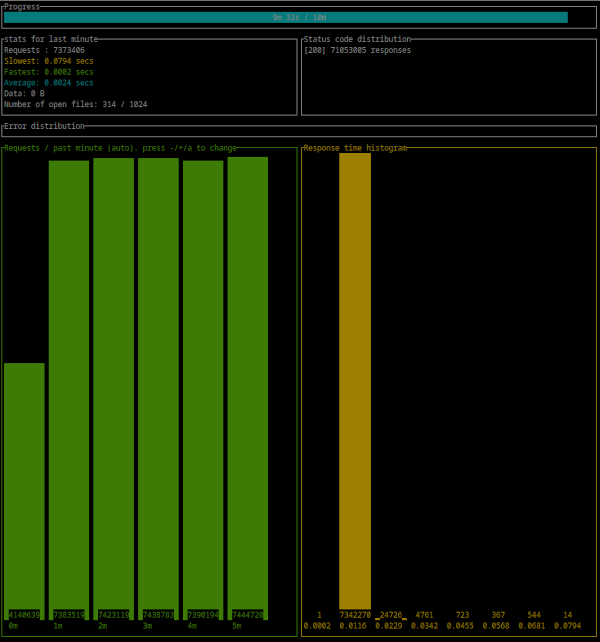
💡 Results reflect synthetic performance under optimal conditions.
- CPU : Intel(R) Xeon(R) CPU E3-1270 v6 @ 3.80GHz
- 300 : simultaneous connections
- Duration : 10 Minutes
- Binary : gazan-x86_64-glibc
Summary:
  Success rate:	100.00%
  Total:	600.0027 secs
  Slowest:	0.2138 secs
  Fastest:	0.0002 secs
  Average:	0.0023 secs
  Requests/sec:	129777.3838

  Total data:	0 B
  Size/request:	0 B
  Size/sec:	0 B

Response time histogram:
  0.000 [1]        |
  0.022 [77668026] |■■■■■■■■■■■■■■■■■■■■■■■■■■■■■■■■
  0.043 [190362]   |
  0.064 [7908]     |
  0.086 [319]      |
  0.107 [4]        |
  0.128 [0]        |
  0.150 [0]        |
  0.171 [0]        |
  0.192 [0]        |
  0.214 [4]        |

Response time distribution:
  10.00% in 0.0012 secs
  25.00% in 0.0016 secs
  50.00% in 0.0020 secs
  75.00% in 0.0026 secs
  90.00% in 0.0033 secs
  95.00% in 0.0040 secs
  99.00% in 0.0078 secs
  99.90% in 0.0278 secs
  99.99% in 0.0434 secs


Details (average, fastest, slowest):
  DNS+dialup:	0.0161 secs, 0.0002 secs, 0.0316 secs
  DNS-lookup:	0.0000 secs, 0.0000 secs, 0.0000 secs

Status code distribution:
  [200] 77866624 responses

Error distribution:
  [158] aborted due to deadline
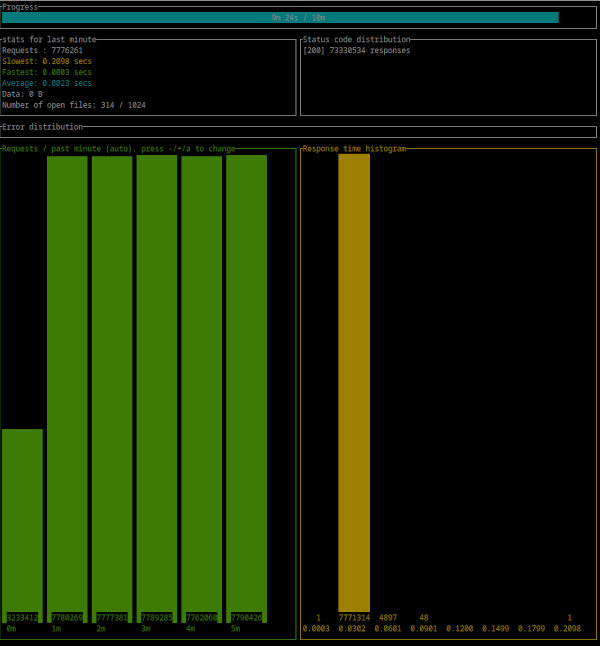
- CPU : Intel(R) Xeon(R) CPU E3-1270 v6 @ 3.80GHz
- 300 : simultaneous connections
- Duration : 10 Minutes
- Binary : gazan-x86_64-musl
Summary:
  Success rate:	100.00%
  Total:	600.0021 secs
  Slowest:	0.2182 secs
  Fastest:	0.0002 secs
  Average:	0.0024 secs
  Requests/sec:	123870.5820

  Total data:	0 B
  Size/request:	0 B
  Size/sec:	0 B

Response time histogram:
  0.000 [1]        |
  0.022 [74254679] |■■■■■■■■■■■■■■■■■■■■■■■■■■■■■■■■
  0.044 [61400]    |
  0.066 [5911]     |
  0.087 [385]      |
  0.109 [0]        |
  0.131 [0]        |
  0.153 [0]        |
  0.175 [0]        |
  0.196 [0]        |
  0.218 [1]        |

Response time distribution:
  10.00% in 0.0012 secs
  25.00% in 0.0016 secs
  50.00% in 0.0021 secs
  75.00% in 0.0028 secs
  90.00% in 0.0037 secs
  95.00% in 0.0045 secs
  99.00% in 0.0077 secs
  99.90% in 0.0214 secs
  99.99% in 0.0424 secs


Details (average, fastest, slowest):
  DNS+dialup:	0.0066 secs, 0.0002 secs, 0.0210 secs
  DNS-lookup:	0.0000 secs, 0.0000 secs, 0.0000 secs

Status code distribution:
  [200] 74322377 responses

Error distribution:
  [228] aborted due to deadline